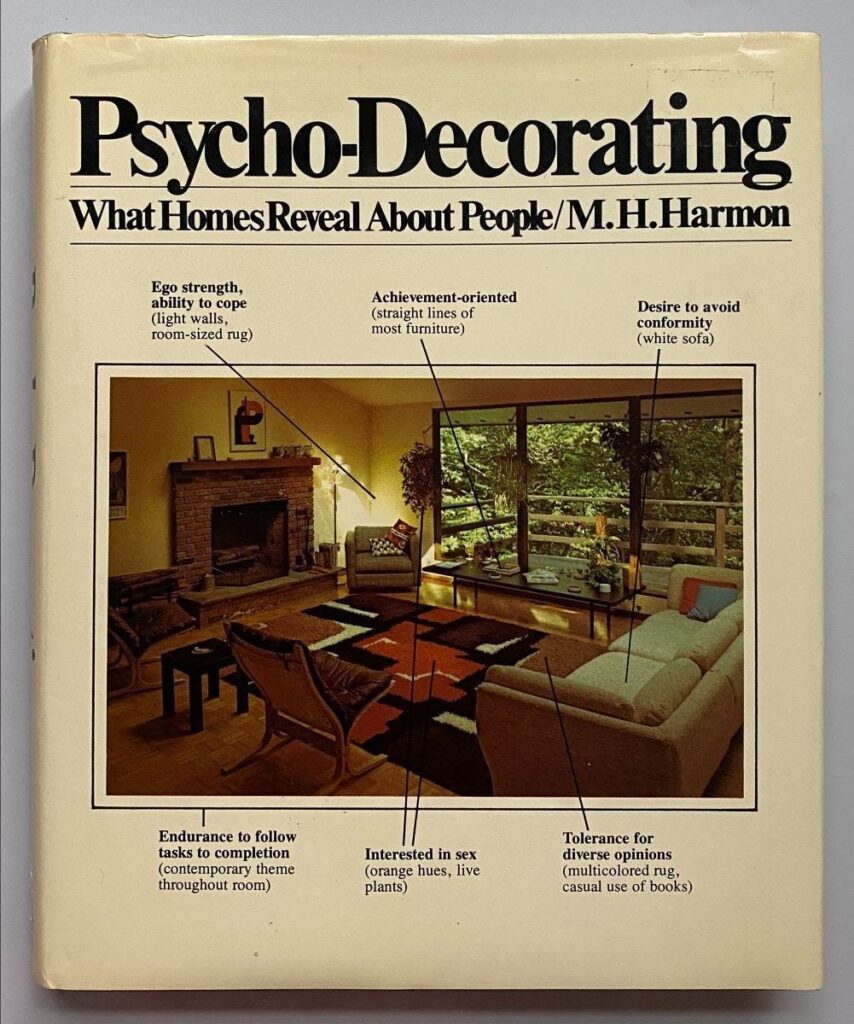
One of the books I’ve been reading this past month is Psycho-Decorating: What Homes Reveal About People by Margaret H. Harmon, Ph.D. Harmon was an American psychologist who wrote this book in 1977 analyzing the relationship between the personalities of people and their homes. It’s a little hard to come by and can be pricey, but there are usually a few copies on eBay. Collecting books on art, design, history, and interiors has been an important part of my life ever since I can remember.
What is psycho-decorating?
One of my small pleasures is being invited into someone’s home for the first time. It’s such a significant moment. Sometimes, we see snippets of people’s homes because of social media. Their kitchen counter, office nook, bedside table, and dining room. You see these different vignettes of their home, but it’s not until you visit their home for the first time that you can piece it all together. Of course, this makes sense! This is the layout! This is so their vibe! This is beautiful! If you go into someone’s home and it accurately represents their personality, you know they’ve done a good job at decorating their space.
Psycho-decorating is defined as the connection between the psyche and the interior decoration that a person creates.
There are exceptions, which Dr. Harmon does note in the book. Maybe someone’s too busy with work or going through something tough in their personal life. Another scenario I can think of is maybe they live with roommates and they’re not able to express themselves beyond their bedrooms. There are a lot of factors, but for this, we’re going to assume that people are intentionally taking the time to decorate their spaces. Note: this book was written in 1977 and some things may have changed since then.
When it comes to my own space, I’ve thought about how much has been updated, since I moved about a million times already. My first couch in NYC was gray and from KEA. My second was a light brown corduroy sectional also from IKEA. My current one is brownish and was taken from the previous owners since it was almost new and hands-down the most comfortable and practical one I have ever had. And most likely, I’m bound to go through a couple of more couches.
Textures and patterns
As people, we’re constantly growing and changing, so it only makes sense that our spaces also go through edits, too. Some things you’ll want to keep around in every space you’re in, like a great lamp, valuables trinkets or a favorite piece of art. But we tend to want to update pieces that can bring a more drastic change into our space, like a rug, or a good bookshelf.
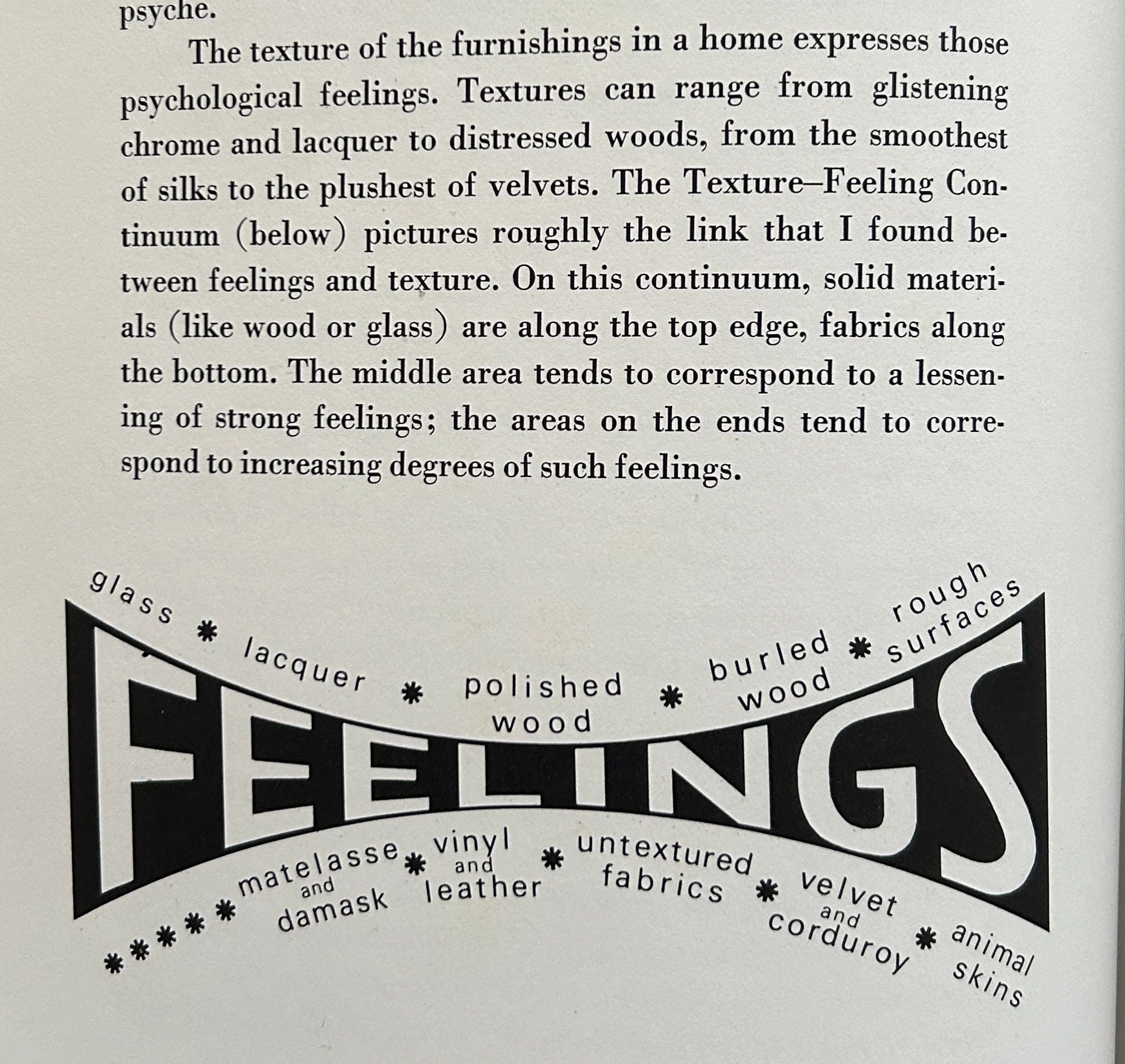
This interesting excerpt is regarding women who gravitate towards velvet and corduroy:
“Turning towards textures at the extreme ends of the continuum, women who are high in sexual needs are inclinded to use velvet or curudory in their living room sofas…their preference for deeply textured fabrics may reflect their strong affective feelings…[These fabrics] were also favored by women with highly-developed consciences and feelings about social justice, but they like to include a variety of other textures along with the velvets. They are partial to burled wood…[and] as a counterbalance, [they] also like to include some furniture covered in leather or vinyl.”
It also points out the most telling signs to look for when uncovering someone’s personality through their decor: straight vs. curved lines in furniture, texture, pattern, symbols and signs, and color, to name a few.
“Patterns can supply cues about interpersonal relations. Using many patterns in one’s living room, I’ve found, indicates friendliness, sensitivity, and ego-strenth (the ability to cope). Those who like to be independent of other people and free to follow their own inclinations tend to use fewer patterns in their living rooms. People who wish to be friendly not only tend to use more patterns but they like to use curved lines and avoid straight ones on their living room chairs.”
The fear of decorating
You can also tell a lot about someone based on how they talk about decorating in casual conversation. Some people may be scared to make mistakes (even though that’s such a big part of decorating your space and finding out what works. Some people don’t think they’re capable of making decisions on their own, so they hire an interior designer to do it all. Note: it’s not bad to hire an interior designer, but a good interior designer “…believes that clients should not abdicate completely all responsibilities, but should make their tastes and feelings known to their decorators.”
“For most people, however, refusing to take part in the decorating of one’s home seems to represent a refusal to step into the unknown parts of one’s personality, perhaps because one’s standards are extremely high or possibly one’s self-image is low.”
The strongest home decorators are those who have a desire to “assert individuality and a willingness to depart from the beaten path.” I believe that all the objects in our homes are what make our homes our homes. We’re proud to have them on display because they represent us and help us express ourselves through our spaces.
The rest of the book is filled with even more gems, like what it means if only one person in your household decorates (me!) or how to properly read someone’s coffee table. Not everything will apply to every person, but I do think it’s interesting this book comes from a psychologist in the 70s. I still have more to read so I’ll need to do Part II. But I’ll leave you with another excerpt of things to keep in mind:
“People’s homes contain signals about the way they look at life. Is a person open-minded? Do [they] view the world as is, or is there a tendency to look at it through rose-colored glasses? What are some of the clues that can tell you about these important atttudes?
One of the surest indicators is the presence or absence of bookshelves in the living room. Tolerant individuals, willing to entertain new ideas and diverse opinions, are more likely to have bookshelves in their living room. People who do not have bookshelves in their living room tend to be somewhat dominant and aggressive in their attitudes. Perhaps they are slightly less open to viewpoints different from their own.”
It’s fascinating how we pour ourselves into our spaces—our wall colors, bedding choices, taste in rugs, and dining table decisions all stem from somewhere within us.
Also, if you find this book anywhere online, please buy me a copy.