
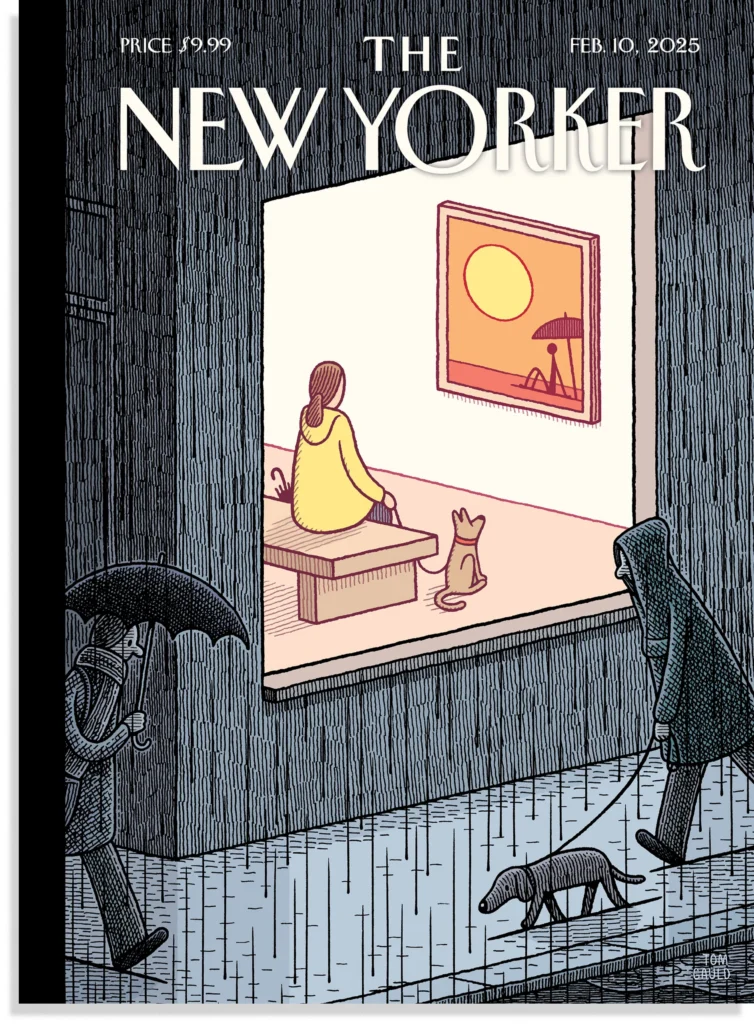
via The New Yorker
We learnt self-pity when we were young. It was a sunny Sunday afternoon; you were 9 years old. Your parents wouldn’t let you have any ice cream unless you did your maths homework. It was achingly unfair. Every other child in the world was playing football or watching television. No one else has such a mean mother. It was just awful. We are all, in theory, dead against self-pity. It seems deeply unattractive because it reveals egoism in its most basic form: the failure to put our own suffering into proper perspective against the larger backdrop of human history. We lament our tiny disasters and look coldly on the grand tragedies of the world. A problem with one’s fringe or a wrongly cooked steak dominates the mind while we ignore work conditions in China, for example.
No one likes to own up to self-pity. And yet, if we are honest, it’s something we feel quite often. And in fact, it’s often a rather sweet emotion. The fact is, we do deserve a great deal more pity than other people are ever very likely to bestow upon us. Life is, in truth, horrendously hard in many ways, even if one does have a top-notch data plan and an elegantly designed fridge. Our talents are never fairly recognised, our best years will necessarily drift away, and we won’t find all the love we need. We deserve pity, and there isn’t anyone else around to give it to us, so we have to give ourselves a fair dose. The operative cause might, from a lofty perspective, seem ridiculous – poor me, I will never drive a Ferrari; it’s so sad, I thought we were going to a Japanese restaurant, and they have booked a pub. But these are just the convenient opportunities for immersing ourselves in a much bigger issue: the fundamental sorrows of existence, for which we do genuinely deserve the most tender compassion.
Imagine what things would be like if we couldn’t pity ourselves. We would be in that far worse category of mental discomfort: depressed. The depressed person is someone who has lost the art of self-pity, who has become too rigorous with themselves. If you think of a parent comforting a child, they often spend hours on a very minor thing: a lost toy, the children’s party to which one was not invited. They are not being ridiculous; they are, in effect, teaching the child how to look after themselves and giving space to the important idea that “small” upsets can have very large internal consequences. Gradually, we learn to mimic this parental attitude with ourselves and come to feel sorry for ourselves when no one else will. It is not necessarily entirely rational, but it is a coping mechanism.
It is a first protective shell, which we develop in order to be able to manage some of the immense disappointments and frustrations that life throws at us. The defensive posture of self-pity is far from contemptible. It is touching and important. Many religions have given expression to this attitude by inventing deities who look with inexpressible pity upon human beings. In Catholicism, for instance, the Virgin Mary is often presented as weeping out of tenderness for the miseries of normal human life. Such kindly beings are really projections of our own need to be pitied.
Self-pity is compassion we extend to ourselves. A more mature aspect of the self turns to the weak and lost parts of the psyche and comforts them, strokes them, tells them it understands and that they are indeed lovely but misunderstood. It allows them to be, for a while, a bit babyish – since that is actually what they are. It provides the undemanding, confirming love that every baby, but far more importantly, every adult, needs to get through the anguish of existence.
The hope is that we can, for a while, turn away from current affairs towards the elevated, the silent, and the eternal. Normally, we are immersed in practical, self-justifying outlooks that are the hallmarks of what we could call “lower” consciousness. At such moments, the world reveals itself as quite different: a place of suffering and misguided effort, full of people striving to be heard and lashing out against others, but also a place of tenderness and longing, beauty and touching vulnerability. One’s own life feels less precious; one can contemplate being no longer present with tranquility. One’s interests are put aside, and one may imaginatively fuse with transient or natural things: trees, the wind, clouds, nature, or waves breaking on the shore. From this point of view, status is nothing, possessions don’t matter, and grievances lose their urgency. If certain people could encounter us at this point, they might be amazed at our transformation and at our newfound generosity and empathy.
Fusing with nature might help and is probably better than doomscrolling Instagram or the news while stress-eating chocolate. When I feel down, I return to (and share) my go-to strategies for resetting whenever things feel particularly heavy.
Unplug (No Really, Put the Phone Down)
We were not designed to mainline news and information 24/7. Try this: set a timer for 30 minutes of phone-free time. Go for a walk without it. Leave it in another room while you eat dinner. Delete the news apps or social media for a day or a weekend. Whatever helps you break the scroll-panic-scroll cycle.
Focus on Your Actual Sphere of Influence
This takes practice but I’m trying to focus my attention on my actual sphere of influence – the tiny actions I can take each day that can make a real impact. This can be as tiny as being kind to the people I encounter at the grocery store, spending quality time with my kid before bed, or helping a friend.
Try a Flow State Activity
Flow state is when you become so absorbed in an activity that your brain stops spinning and time disappears. For some people, it’s working on a giant puzzle, baking a pie from scratch, or getting lost in a craft project. I find flow when I’m cleaning out my closet or reorganizing a junk drawer. Figure out what works for you now, so you have it ready when you need it most.
Get Up and Move
When I had a hard time at work, I have a strong pull to stay on the couch, be grumpy, and eat foods that are terrible for my body. Sometimes I succumb, but whenever possible, I push myself to get outside and move – some fresh air and a walk around the neighborhood, a yoga class, jogging, or a walk with a friend. It always helps.
Write Write Write
Writing has always been deeply therapeutic for me. It’s a way of cleaning out my brain, downloading the swirl, and (sometimes / often) gaining clarity and perspective. I just set a blank notebook on my desk and have started writing a few pages each morning when I wake up, but most often in the evening.
Be So Nice to Yourself
Don’t skip this one. When things get stressful, self-care can go straight out the window. Now is the time to practice good boundaries, self-compassion, stay hydrated, eat well, and rest up.
Watch a Comfort Show
Sometimes you really do just need to curl up into a ball and fully check out. For those times, I recommend plugging into a great show or movie that feels like a warm hug. Taking all the recs.
So, to bring a bit of positivity to everything, focus on what you are doing with your life right now. How are your relationships going? What are your backup plans? What do you value and why? We should make the most of them when they arise and harvest their insights for the time when we require them most. And, the surest way to correct faulty thinking is the repetition of concise, constructive, harmonious thoughts. Now, cheer up, buttercup.