I moved so many times in my life that I almost lost track of all the different places. But one particular apartment in New York City came up in a conversation the other day. It was that time when a plumber knocked on my door, and I thought he had the wrong apartment. He was looking for water damage, and I sent him to try my neighbor’s door. Two days later, loud banging commenced above my apartment. First, the dull thump of plaster walls being demolished, and then the distinctive clang of metal against metal. Eventually, I heard large pieces of rubble falling between the walls. The sound was so close it inspired me to get down on my hands and knees to see if some of my plaster had come loose from the wall my bookcases leaned against.
With my face pressed against the floor, I could see what I couldn’t see before: Quite a lot of water damage behind my bookcases. The super was summoned. The plumber returned with what I suspected was an I-told-you-so look on his face. It was determined that I would need to move all three bookcases to assess the damage, which meant moving a lot of books. (Fortunately, books and cases were undamaged by the water.)
There is nothing like having to move your belongings to force you to confront them.
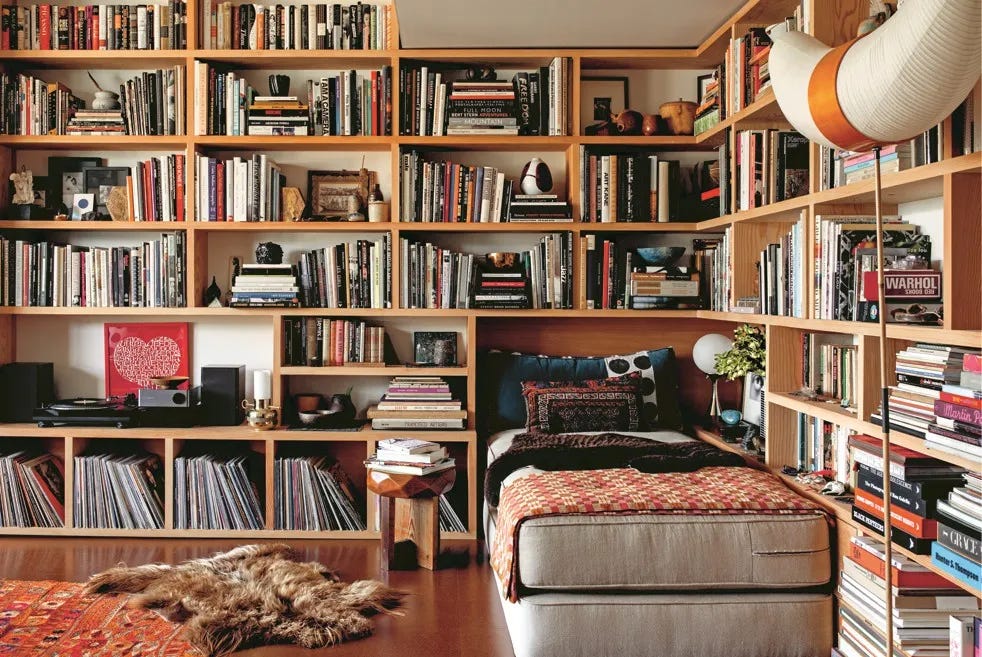
As I waited a couple of days for the plasterer to come, my living room and foyer were a maze of stacked book towers. The books took up a shocking amount of place loosed from their usual confines. This situation got me thinking I should prune our collection a bit. Before the unshelving, some books had been shelved two rows deep. There were others wedged in horizontally on top of other books. Some large tomes perched atop the cases. The truth is, I had long ago outgrown my book storage.
I’m pretty good at letting go of things, but books are something of a weak point. (The last time I counted, since I live in my house in Vienna, I had at least 500 books). I’ve gotten pretty good at passing on novels I’ve read, agreeing with Nan Talese, who once said, “I don’t reread old books, there’s too much to read.” What I struggle with are nonfiction books (interiors books, health, cookbooks, art books, etc.).
In her best-selling book The Life Changing Magic of Tidying Up, Marie Kondo instructed her readers to do what I was forced to do: Take every single book off the shelf. Kondo wants you to pick up the book and decide if the sight of it sparks joy—and only keep those that do. She cautions, “Make sure you don’t start reading it. Reading clouds your judgement.” I suppose this method might be quite effective, but I’m not that steadfast: I can’t help but crack a book open before giving it away.
While living amongst the book stacks, I’d pick up a title, thinking that we might be ready to part ways. But before I put it on the to-donate pile, I’d just flip through and make sure it wasn’t a keeper. Inevitably, I would find something that delighted me in its pages: A recipe I made once and loved, a garden I’d like to visit someday, or photos of an apartment that left a big impression on me years ago and still stops me in my tracks. In almost every case, I decided not to donate the book.
Does this sound familiar? I’m betting it does. I found myself wondering why it’s so hard to part with books, and I concluded that it’s a general feeling that you might read it again someday, but there are different reasons for different books. If you, too, struggle to winnow down your library, it might help to think about why it’s so hard; here’s why:
We spent money on them.
I suspect every reader has books they bought and never read. I know I do. We think we’ll get to them someday, but often these books linger unread for years. This is a category of books that I’d encourage you to let go of by giving them away to friends or donation. If you really want to read the book later, you can always get another copy.
We might reference it someday.
Maybe this is more of a problem for writers, but there are so many books that I keep because I’m sure they’ll be a useful reference someday. One little workaround I’ve found for this type of book involves two apps. Here’s how it works: I borrow the book from the library, or I fire up the Kindle app on my desktop, where I can easily search for the bit of text I am looking for.
They’re “classics.”
Often, it’s hard to let go of a book that is a great work of literature. For one, these books seem like ones we’ll be more likely to reread, but I think there’s a deeper reason that they linger. “Important” books are often part of our identity: We see ourselves as the person who read Henry James and Gabriel Garcia Marquez. I’ve gotten better about letting these go, shedding most of the books that date back to my undergrad literature studies. Know that if you ever want to read a classic again, any library will have it. However, I have struggled to let go of the Scribner’s Library paperbacks (you know the ones with the gray backdrop and colorblock title backdrops) that I bought at used bookshops downtown a thousand years ago, which leads to my next reason it’s hard to declutter books.
We’re sentimental.
I have kept a copy of Samantha Irby’s short stories that my friend suggested I read because she thought my non-fiction was in a similar vein. (I read that book so closely, looking for clues!) At fortysomething, I’ve still been holding onto my copy of Sara the Little Princess by Frances Hodgson Burnett because it was my favorite book as a kid. I will probably keep the children’s book The Very Hungry Caterpillar until the day I die because it sparks a tender memory: My then two-year-old, now thirteen-year-old, marched right over to this book in a bookshop and managed to communicate we MUST buy it. I did, and then on a Monday in preschool, I saw it in his classroom. The teacher had read it to the kids, and he had recognized it. Oh my heart.
The walls of my apartment in New York City had been replastered, and the bookcases were put back in place, the titles reshelved. And of course, I added more books, but some I had to let go simply because I moved so many times.
It is important to dig deep and pick some books to say goodbye to. But I also want to make space for new books—new ideas, new chapters in life. (I also hate the way an overcrowded bookshelf looks.) So, I will endeavor to keep pruning. Maybe I should host a book swap to give some away?
A sliver of salvation for our crowded shelves came from my almost 13-year-old son. I asked him to identify some books to give away and he swiftly and unsentimentally divided his stack into keep and give piles–no sentimental hesitations.
Happy reading and book hoarding, my lovelies.